Hesitant to speak English at work or in daily conversations? Discover a practical step-by-step guide to build fluency, overcome fear, and speak English with confidence even if you are a complete beginner.
Struggling to speak confidently in professional meetings? Learn essential Business English phrases, vocabulary, and polite interruption techniques to express your ideas clearly and advance your career.
Mastering advanced English literature is the ultimate gateway to vocabulary expansion and sharp communication. Explore 10 seminal masterpieces that transformed prose, critical thought, and modern writing.
Want to unlock higher-paying career opportunities? Discover our comprehensive, step-by-step guide to mastering English for career growth, covering beginner foundation building to executive-level fluency.
Discover the 5 best free English learning tools in 2026 to boost your grammar, vocabulary, speaking, and writing skills. Whether you’re a beginner building daily habits or preparing for IELTS/TOEFL exams, this complete guide compares top platforms like Duolingo, BBC Learning English, and Grammarly to help you achieve fluency without spending a dime.
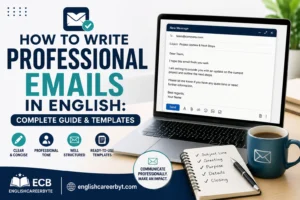
Learn how to write professional emails in English with step-by-step guidance, high-converting subject lines, effective greetings, and copy-paste workplace email templates.
Learn how mastering English communication can double your earning potential in 2026. Explore high-paying industries, salary comparisons, and a practical 30-day fluency roadmap for career success.
Stop copying boring Fiverr gig descriptions. Here are 3 copy-paste gig description samples (Content Writing, Canva Design, Data Entry) that actually get orders in 2026. Includes Fiverr SEO formula and mistakes to avoid.
Do you freeze the moment an interviewer asks, "What is your biggest weakness?" You are not alone — this is one of the most feared interview questions for job seekers across Pakistan and India. The good news: there's a simple formula for this weakness interview answer, and once you learn it, you'll never feel stuck again. Below you'll find 7 real examples, a step-by-step method, and the mistakes to avoid.
Why Interviewers Ask About Your Biggest Weakness
This question isn't a trap. Interviewers ask it to check three things about you.
🪞
Self-Awareness
Do you actually know your own strengths and limits?
🤝
Honesty
Can you admit something real, not a rehearsed line?
🌱
Growth Mindset
Are you actively improving, or do you stay stuck?
How to Answer This Question (Step-by-Step)
Every strong weakness interview answer follows the same simple 3-step formula.
01
Choose a Real (But Safe) Weakness
Pick something true, but not a core skill needed for the role you're applying for.
02
Show What You're Doing About It
Don't just name the weakness — explain the action you're taking to improve it.
03
End With a Positive Result
Close with proof it's working: a habit you built or feedback you've received.
💡
Pro Tip: Practice your answer out loud 3–4 times before the interview. For a confident opener too, see our guide on how to introduce yourself in a job interview.
7 Best Weakness Examples for Interviews
Adapt any of these to your own experience — all are honest, safe, and easy to personalize.
🎤
1. Public Speaking Anxiety
Sample answer"I used to get nervous presenting to large groups. I joined a public speaking club at university, and now I actively volunteer for presentations."
🤲
2. Delegating Tasks
Sample answer"I like doing things myself to make sure they're right. I'm learning to trust my team and now assign clear tasks with deadlines."
🔍
3. Perfectionism
Sample answer"I sometimes spend too long polishing small details. I've started setting time limits for each task to stay on schedule."
⏱️
4. Impatience With Slow Processes
Sample answer"I get frustrated when projects move slowly. I've learned to break big goals into smaller milestones so progress feels faster."
🙅
5. Difficulty Saying No
Sample answer"I used to take on too many tasks at once. Now I prioritize my workload weekly and communicate honestly about my capacity."
🧰
6. Limited Experience With a New Tool
Sample answer"I'm still building my skills in advanced Excel formulas. I'm currently taking an online course to strengthen this area."
⚖️
7. Overworking / Work-Life Balance
Sample answer"I tend to stay late to finish everything. I've started using a daily planner to manage my time better during work hours."
Common Mistakes to Avoid
Saying "I have no weaknesses" — this sounds dishonest, not confident.
Fake weaknesses like "I work too hard" — interviewers hear this constantly.
Being too negative — don't oversell a weakness unfit for the role.
Sounding memorized — practice the idea, not word-for-word lines.
Ignoring the job description — avoid a weakness tied to the role's core skill.
A good weakness is true but not essential to the job — like perfectionism, delegating, or public speaking nerves — paired with a clear example of how you're improving it.
How do you answer weaknesses in an interview?
Use the 3-step formula: name a real weakness, explain the action you're taking to improve, and end with a positive result or lesson learned.
Should I say I have no weaknesses?
No. This makes you sound unaware or dishonest. Interviewers expect a real answer that shows self-awareness and growth.
Can I use the same weakness answer for every job?
You can reuse the same weakness, but always adjust your example slightly to match the specific role and company you're applying to.
In short: pick a real weakness, show your growth, and end on a positive note that's it. Try writing your own answer using the formula above, and practice it before your next interview.
Found this helpful? Check next, or drop your weakness answer below we'd love to help you refine it.