In today’s hyper-connected international economy, professional success is no longer determined solely by domain expertise, technical qualifications, or years of industry experience. A vital catalyst that determines career trajectory, earning potential, and leadership mobility is effective communication. Because English is the most powerful language in global trade, technology, finance, and diplomacy, mastering business communication has transitioned from an advantageous skill to an absolute career necessity.
Whether you are aiming to secure a remote position with a global tech enterprise, pitch high-value proposals to international stakeholders, or confidently lead cross-functional teams, your ability to articulate ideas clearly in English directly influences your professional trajectory. Research consistently shows that professionals with advanced Business English proficiency earn significantly higher salaries, secure promotions faster, and adapt more resiliently to changing market conditions.
However, moving from basic comprehension to effortless workplace fluency requires a systematic roadmap. Many career professionals spend years studying vocabulary and grammar rules without ever achieving natural speaking confidence or polished writing skills. This guide provides a battle-tested, step-by-step roadmap to elevate your English skills from basic comprehension to executive-level fluency, engineered specifically for long-term career growth.
- 1. Why English Proficiency is Essential for Modern Career Success
- 2. Phase 1: Building a Rock-Solid Beginner Foundation
- 3. Phase 2: Intermediate Skills for Everyday Workplace Communication
- 4. Phase 3: Advanced Executive Fluency and Leadership Communication
- 5. The Ultimate 90-Day Career English Action Plan
- 6. Recommended Tools and Resources for Daily Practice
- 7. Frequently Asked Questions (FAQ)
1. Why English Proficiency is Essential for Modern Career Success
To understand the career impact of English proficiency, consider how global organizations operate today. Multinational corporations, fast-scaling startups, and digital service providers rely on English as their default lingua franca. When team members span multiple continents, standardized communication ensures operational alignment and mitigates costly misunderstandings.
🚀 Career Advancement & Mobility
Fluency opens doors to international placements, regional management roles, and cross-border leadership opportunities that are closed to non-English speakers.
💰 Earning Potential Premium
Studies show that bilingual and fluent English professionals in non-native English countries command a 30% to 50% salary premium over their peers in identical technical roles.
Beyond financial incentives, English literacy grants direct access to cutting-edge research, industry certifications, executive training programs, and global networks. According to global data from [Cambridge Assessment English](https://www.cambridgeenglish.org/), over 95% of employers in non-English speaking nations explicitly test or evaluate English communication skills during recruitment for managerial positions.
In addition, the rise of AI technology, remote working environments, and global freelancing platforms means your primary interaction with colleagues or clients is written and verbal. If your emails are ambiguous or your oral presentations lack clarity, your professional credibility declines—regardless of how brilliant your technical insights might be.
2. Phase 1: Building a Rock-Solid Beginner Foundation
If you are starting from a basic or beginner level, the goal is not to master complex literary devices or memorise archaic vocabulary words. Instead, your primary focus must be on functional clarity and building emotional resilience against mistakes.
2.1 Overcoming Speaking Anxiety and Mindset Blockages
The single greatest barrier for adult language learners is the fear of making grammatical errors in front of colleagues. This anxiety triggers hesitation, leading to awkward pauses, fast quiet speaking, or complete silence during crucial workplace moments.
💡 Mindset Shift for Professionals
Business communication values clarity over perfection. Global business partners care far more about receiving precise data, logical arguments, and actionable solutions than whether you misplaced a preposition or omitted an article.
- Practice Low-Stakes Speaking Daily: Record yourself reading a short business article aloud for 3 minutes every morning. Listen to the recording to evaluate your pacing and tone without harsh self-judgment.
- Use the "Shadowing" Technique: Listen to professional podcasts or TED Talks, pause after every sentence, and repeat the speech out loud, matching the speaker's cadence, stress, and intonation.
- Focus on Key Concepts: Structure your thoughts around simple sentences (Subject + Verb + Object) before attempting long, compound structures.
2.2 Core Business Vocabulary & Pronunciation Basics
Beginner professionals often make the mistake of studying general English vocabulary lists. To accelerate career relevance, focus exclusively on high-frequency workplace vocabulary and common industry terminology.
| Category | Essential Phrases & Terms | Workplace Context |
|---|---|---|
| Project Status | In progress, On schedule, Delayed, Action item, Deliverable | Updating managers and team members during status checks. |
| Agreement & Input | I propose, From my perspective, I concur, Alternatively | Sharing opinions constructively during team meetings. |
| Clarification | Could you elaborate on...?, To clarify, Correct me if I'm wrong | Ensuring task requirements are fully understood before execution. |
Clear pronunciation is equally vital. Pay close attention to word stress and syllable pronunciation in key professional terms (e.g., DE-ve-lop-ment vs. de-VE-lop-ment). Clear articulation ensures your message is received correctly without forcing listeners to strain.
3. Phase 2: Intermediate Skills for Everyday Workplace Communication
Once you possess functional comprehension, phase two focuses on transforming passive knowledge into smooth, reactive communication during daily office workflows.
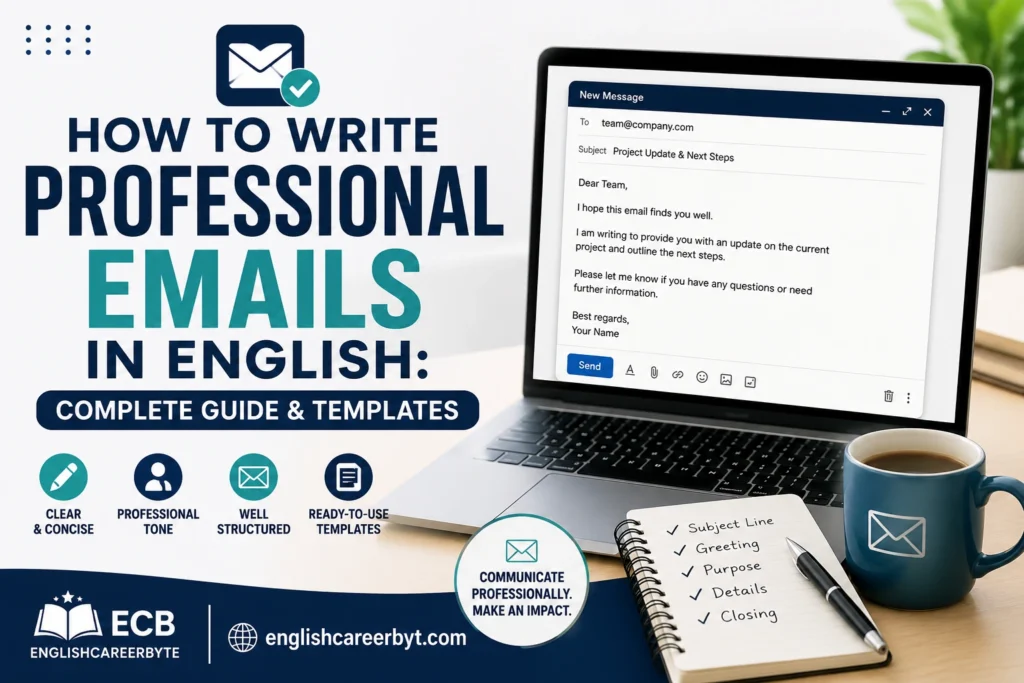
3.1 Professional Email Etiquette and Written Communication
In modern corporate environments, your written correspondence functions as your digital handshake. Poorly structured emails lead to confusion, endless back-and-forth threads, and an impression of unprofessionalism.
📧 The 4-Part Structure of Executive Emails
- Clear Subject Line: State the exact purpose (e.g., [Action Required] Q3 Budget Review Approval).
- Professional Opening & Context: Start with a polite greeting followed by a 1-sentence explanation of why you are writing.
- Bulleted Core Details: Break dense information into scannable, bulleted lists.
- Explicit Call to Action (CTA): Clearly define who needs to do what, along with specific deadlines.
Compare these two email approaches:
❌ Weak Email: "Hi, I am writing to tell you about the project. We have some problems with the timeline and need to talk about budget changes when you are free."
✅ Professional Email: "Dear Mark,
I am writing to share an update regarding the timeline for Project Alpha. Due to extended testing, we require a 3-day extension. Could we review the revised schedule during tomorrow’s 10:00 AM sync?"
3.2 Participating Confidently in Meetings and Discussions
Intermediate learners often struggle to join fast-paced group discussions in English. By the time they translate their thoughts from their native language, the conversation has moved on to another topic.
To overcome this challenge, utilize pre-scripted transition phrases that allow you to interject politely and buy time to construct your statement:
- To interject respectfully: "May I add a quick point regarding..."
- To transition topics: "Building on what Sarah mentioned, we should also consider..."
- To buy thinking time: "That’s an insightful question. Let me break down the core components..."
4. Phase 3: Advanced Executive Fluency and Leadership Communication
The final phase of English proficiency centers on executive presence, persuasive storytelling, strategic negotiation, and leading high-performing international teams.
4.1 High-Stakes Presentations and Persuasive Pitching
Delivering impact at the executive level requires organizing complex data into compelling narrative frameworks. Advanced professionals rely on structured presentation formulas like the Problem-Solution-Benefit (PSB) Framework.
Structured Pitching Model
1. Hook & Problem: "Currently, customer onboarding takes 14 days, resulting in a 20% drop-off rate."
2. Proposed Solution: "By automating document verification through our new platform..."
3. Quantifiable Benefit: "...we can reduce onboarding time to 48 hours and boost retention by 35%."
Mastering signposting vocabulary is critical during formal slide presentations. Use transition markers like "Now let us turn our attention to...", "This brings us to our next point...", and "To summarize our key strategic takeaway..." to guide your audience through complex analyses effortlessly.
4.2 Strategic Negotiation and Conflict Resolution
Negotiating in English requires diplomatic language, active listening, and soft skills. Direct, aggressive language can close off dialogue, whereas diplomatic phrasing keeps conversations constructive.
🕊️ Softening Language for Diplomacy
Instead of blunt, confrontational assertions, use diplomatic hedges:
- Instead of: "Your timeline is unrealistic." → Use: "We might face operational bottlenecks if we adhere to that specific deadline."
- Instead of: "We cannot accept this price." → Use: "That pricing structure presents challenges for our current budget constraints."
5. The Ultimate 90-Day Career English Action Plan
Consistency outperforms intensity when acquiring language skills. Follow this structured 90-day blueprint to elevate your workplace fluency systematically.
| Timeframe | Primary Focus Areas | Daily Action Steps | Measurable Milestone |
|---|---|---|---|
| Days 1–30 Foundation & Pronunciation |
• High-frequency vocabulary • Basic sentence structures • Confidence building |
• Read industry news for 15 minutes. • Record 3-minute oral summaries. • Shadow 1 short professional video. | Deliver a smooth 2-minute personal elevator pitch without hesitation. |
| Days 31–60 Workplace Integration |
• Email writing frameworks • Meeting interjections • Professional grammar |
• Draft emails using scannable bullet points. • Speak up at least once in every meeting. • Maintain a personal workplace phrasebook. | Successfully run or lead a 15-minute workplace presentation in English. |
| Days 61–90 Executive Presence |
• Persuasive pitching • Diplomatic negotiation • Advanced storytelling |
• Practice diplomatic phrasing techniques. • Rehearse responses to unexpected questions. • Debate complex topics with a mentor or peer. | Confidently negotiate a deadline, scope modification, or project proposal in English. |
6. Recommended Tools and Resources for Daily Practice
Accelerate your growth by incorporating modern digital tools into your daily professional routine:
- Writing & Grammar Enhancers: Utilize tools like Grammarly or Hemingway Editor to analyze email readability, tone, and sentence structure before hitting send.
- Vocabulary Expansion: Subscribe to reputable publications like the Harvard Business Review, The Economist, or Wall Street Journal to learn formal industry terminology in context.
- Speech Refinement: Leverage AI audio recorders and language apps to analyze your pronunciation, pacing, and speech clarity over time.
📌 Key Takeaway for Your Career
English proficiency is an investment in your career capital. Perfect grammar is not required to start—consistent daily communication practice is. By shifting your focus toward professional clarity, structured writing, and proactive speaking, you will build the executive communication skills needed to stand out and succeed in today's global economy.
7. Frequently Asked Questions (FAQ)
Q1: How many hours a day should I dedicate to improving my English?
A: Consistency is far more effective than long, sporadic study sessions. Dedicating 30 to 45 minutes daily to active listening, reading, and speaking practice yields faster, more lasting results than studying for hours once a week.
Q2: What should I do if I forget words during an important meeting?
A: Pause calmly, breathe, and use paraphrasing techniques. Phrases such as "Let me rephrase that..." or "What I mean to emphasize is..." allow you to reset your thoughts gracefully without losing executive presence.
Q3: Is learning accent-free English necessary for career success?
A: No. International business values clarity, articulation, and pacing far more than adopting a specific native accent. Focus on speaking clearly, pronouncing key terms correctly, and using professional vocabulary.










One Response