
One take, no pause, no do over. Here's exactly how to prepare for the part of the DET that trips up the most candidates.
The Duolingo English Test has grown from a niche workaround into one of the most widely accepted English proficiency exams in the world, with more than 6,000 institutions across 110+ countries now accepting it for admissions, and in some cases visas. Compared to IELTS or TOEFL, it costs less, takes about an hour, and can be completed from home. For students in Pakistan, Nigeria, Nepal, Bangladesh, Sri Lanka, and across South Asia, it has quickly become the practical alternative to a $250 exam and a long trip to a test center.
The speaking section is where most candidates lose confidence, and it has nothing to do with vocabulary. It comes down to the format itself: you record your answer once, there is no pause button, and for the newest question type you're speaking to an AI interviewer in something close to real time. This guide breaks down exactly what to expect and how to practice each part of it.
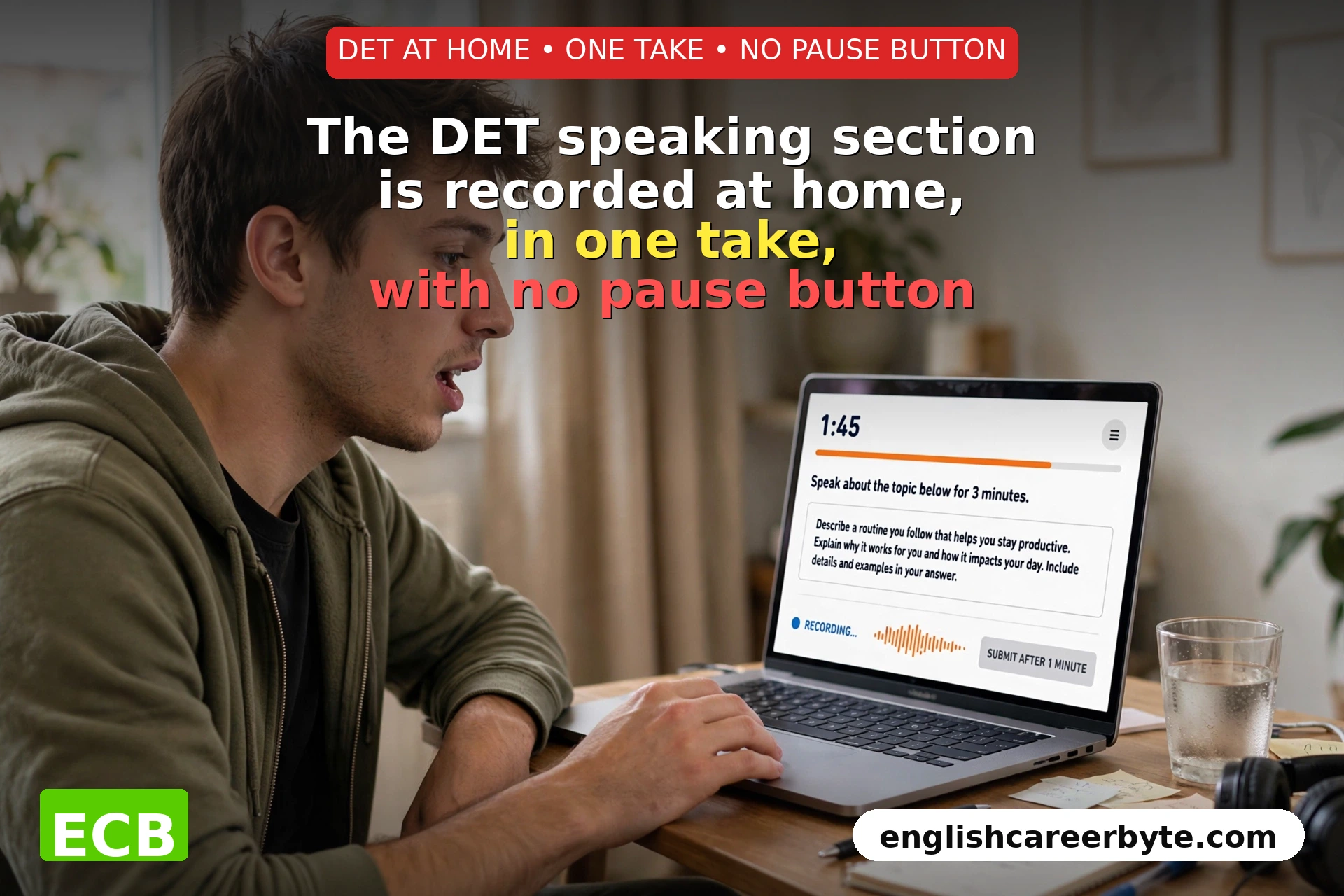
In IELTS, a human examiner sits across from you, nods, asks follow-up questions, and gives you a natural rhythm to talk within. In the DET, none of that exists. You read or hear a prompt, a timer starts, and you speak directly into your webcam, alone, with an AI system recording and scoring the response. There is no examiner to read your body language and no second chance if you stumble on the first sentence.
The skill this section actually tests: not your vocabulary, but your ability to organize a clear answer instantly and speak it out loud without hesitating, since there is no room to recover from a slow start.
As of the 2026 format, the DET includes a mix of scored speaking tasks woven into the adaptive section, plus a separate, unscored Speaking Sample that institutions review directly.
| Question type | What happens | Prep time | Speaking time |
|---|---|---|---|
| Read, Then Speak | You read a short prompt with guiding questions, then give an extended spoken response on the topic. | 20 seconds to read | Up to 90 seconds |
| Speak About the Photo | You're shown an image and describe it in detail. | 20 seconds to study the image | Up to 90 seconds |
| Interactive Speaking (new in 2026) | An AI character asks you 6 to 8 short questions in something close to a live conversation. | No prep time given | Up to 35 seconds per response |
| Speaking Sample | An open-ended prompt, unscored numerically but reviewed directly by admissions officers alongside your Writing Sample. The longest speaking task. | About 30 seconds to prepare | Longest of all speaking tasks |
Your overall DET score falls on a scale of 10 to 160, and it's broken into four subscores: Literacy, Comprehension, Conversation, and Production. Speaking tasks feed primarily into the Conversation and Production subscores, which universities sometimes review separately from your overall score to check your specific spoken ability.
For context, Duolingo's own published data puts the average overall score in the 110 range, which gives you a rough benchmark to aim above, not a pass or fail line, since required scores vary by university and program.
A surprising number of speaking-section problems are technical, not linguistic. Sort these out well before test day.
Both tasks give you a short 20-second window to study the prompt or the image before speaking, and both reward the same structure once you start talking: a clear opening statement, two or three supporting details, and a short closing line, all within 90 seconds.
This is the newest and most unpredictable task, since it plays out closer to a real conversation than a monologue. You'll get a series of 6 to 8 short questions with no preparation time before each one, so the best preparation is practicing short, natural responses rather than long rehearsed speeches, since you'll only have up to 35 seconds to reply.
This is the longest speaking task, with about 30 seconds to prepare before you start. Since this response is reviewed directly by admissions staff, treat it less like a test answer and more like a short, structured self-introduction. Speak clearly, avoid rushing, and use the full time given rather than stopping early.
| Mistake | Do this instead |
|---|---|
| Long silence at the start while thinking | Start with a simple opening sentence immediately, even a basic one, then build detail as you go |
| Speaking in a flat, monotone voice | Vary your pace slightly and emphasize key words, the way you would in a normal conversation |
| Stopping well before the time limit | Practice pacing so you use close to the full 90 seconds, since a short answer signals limited fluency |
| Memorizing full answers word for word | Memorize a flexible structure instead, so you can adapt to whatever prompt or photo appears |
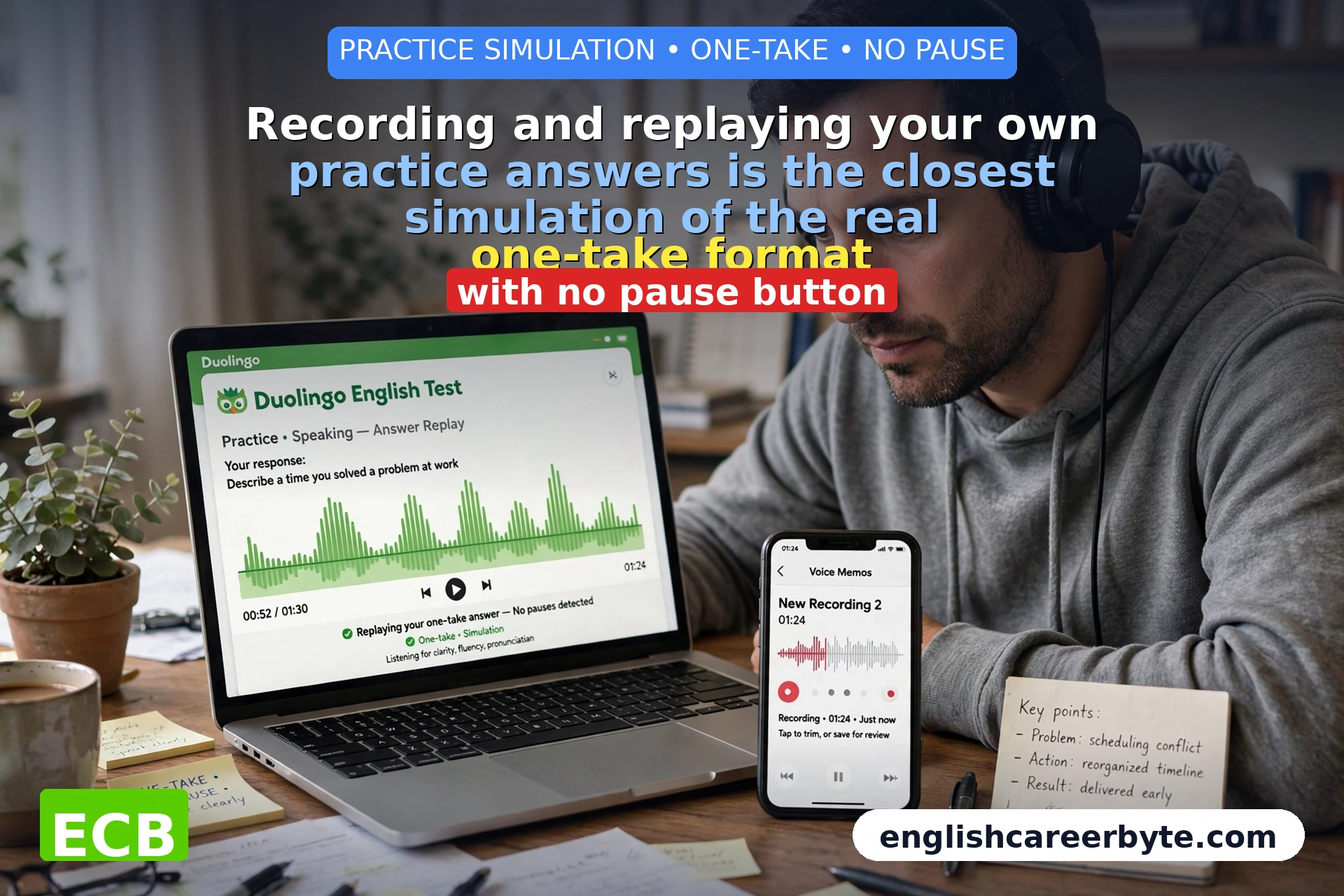
If your fluency under time pressure is the real gap rather than knowing what to say, EnglishCareerByte's free pronunciation and speaking practice tool is built for exactly this kind of drilling, and their free English speaking confidence test gives you an honest baseline before you commit to a test date.
Since DET results are also increasingly used by employers and immigration pathways, not just universities, it's worth pairing this preparation with EnglishCareerByte's guide to 50+ common job interview questions and answers, since many of the same clear, structured speaking habits carry directly into interviews once you're accepted.
Speaking tasks are mixed throughout the 45-minute adaptive section rather than grouped into one block, and together they typically add up to around 10 minutes of actual talking, plus the separate Speaking Sample.
No. Each speaking response is recorded in a single take with no option to pause, rewind, or rerecord, which is exactly why practicing under real time pressure matters more than memorizing perfect answers.
It's a 2026 format addition where an AI character asks you a question in something close to real time, and you respond naturally within about 35 seconds, replacing the older Listen, Then Speak task.
Yes. Speaking tasks feed into the Conversation and Production subscores, which are part of your overall score and are sometimes reviewed separately by universities.
You can retake the DET, though there is a limit on how many times you can test within a 30-day period, so it's worth preparing thoroughly rather than treating the first attempt as practice.
The DET speaking section isn't testing whether you know advanced vocabulary. It's testing whether you can organize your thoughts and speak clearly under real time pressure, with no safety net. That's a trainable skill, and a structured two-week practice routine closes most of the gap between an average score and a genuinely strong one.
Join a free trial class with EnglishCareerByte and get live feedback on your speaking pace and structure.
Start Free Trial →
One Response