ChatGPT can act as a free, 24/7 English tutor but only if you know how to prompt it correctly. This guide gives you the exact setup steps, a level-by-level (CEFR) approach, and more than 60 copy-paste prompts for speaking, writing, vocabulary, and exam prep, plus the limitations most guides don't mention.
What ChatGPT Actually Does for English Learners
ChatGPT is a text (and voice) AI you can talk to like a tutor. Unlike an app with fixed lessons, it generates practice material on demand: it can correct a sentence you just wrote, build you a quiz on phrasal verbs, or hold a five-minute roleplay as a hotel receptionist. That flexibility is its biggest advantage over traditional apps and also why most people get mediocre results, because they ask it vague questions instead of specific, structured prompts.
Before you dive into prompts, it helps to know where you're starting. If you're not sure of your level, try EnglishCareerByte's English level test first every prompt below works better once you can tell ChatGPT your actual CEFR level.
Setting Up ChatGPT for English Practice

- Create or open your account at chatgpt.com or in the mobile app. Sign up with email, Google, or Apple.
- Decide free vs. Plus. Free covers writing, grammar, and vocabulary work fine. Plus (~$20/month) is worth it mainly for heavier Voice Mode use and faster responses during long study sessions.
- Tell it your level and goal in your first message — for example: "I'm a B1 English learner. My goal is to sound more natural in daily conversation. Please correct every mistake I make and explain briefly why."
- Turn on Voice Mode by tapping the headphone/waveform icon in the mobile app to practice speaking and listening together.
- Save a custom instruction in Settings > Custom Instructions so ChatGPT automatically corrects your English in every new chat, not just the current one.
Note: Voice Mode access and daily limits vary by plan and region — check your app for current availability.Prompts by CEFR Level (A1–C2)
Generic prompts get generic answers. The single biggest upgrade you can make is telling ChatGPT your CEFR level every time, based on the official Common European Framework of Reference for Languages (CEFR) descriptors from the Council of Europe.
| Level | Description | Example prompt |
|---|
A1
Beginner | Basic phrases, simple present tense | "I'm an A1 English learner. Use only simple present tense and basic vocabulary. Have a 5-line conversation about my daily routine." |
A2
Elementary | Simple past/future, everyday topics | "I'm A2 level. Ask me 5 questions about my last weekend using past simple tense." |
B1
Intermediate | Connected text, opinions, travel | "I'm B1 level. Roleplay a conversation where I'm checking into a hotel with a problem with my reservation." |
B2
Upper-Intermediate | Complex arguments, abstract topics | "I'm B2 level. Debate me on 'remote work is better than office work' and push back on my weak arguments." |
C1
Advanced | Nuanced, professional, idiomatic | "I'm C1 level. Give me 10 nuanced synonyms for 'important' with the context where each fits best." |
C2
Mastery | Native-like precision, register shifts | "I'm C2 level. Rewrite this paragraph in three registers: academic, casual, and diplomatic. [paste paragraph]" |
If you want to push toward the top of that ladder, EnglishCareerByte's advanced English level guide pairs well with the C1/C2 prompts above.
Speaking Practice Prompts
ChatGPT can't hear your pronunciation on desktop, but Voice Mode changes that. Use these prompts to build real conversational reflexes. For a deeper structured routine alongside these, see EnglishCareerByte's best speaking practice guide.
1"Let's have a casual conversation about [topic]. Correct my grammar mistakes after each of my replies, but keep the conversation flowing."
2"Roleplay: you're a barista, I'm ordering coffee. Start the conversation."
3"Roleplay a job interview for a [job title] position. Ask me one question at a time and give feedback after each answer."
4"I'll describe my day out loud. Point out any awkward phrasing and suggest a more natural way to say it."
5"Give me a random conversation topic and 3 follow-up questions to keep me talking for 2 minutes."
6"Let's practice small talk for a work networking event. Start with a greeting."
7"Act as a native speaker friend. Talk to me only in casual, informal English."
8"Give me a tongue twister and then explain the specific sounds it's testing."
9"I'm going to describe a picture from memory. Ask me clarifying questions like a curious listener would."
10"Roleplay calling a restaurant to make a reservation. Include a complication, like the time I want being unavailable."
11"Ask me 5 rapid-fire opinion questions and don't let me answer with just 'yes' or 'no.'"
12"Let's practice giving directions. You ask how to get somewhere and I'll explain."
13"Pretend to be a doctor. I'll describe symptoms and you ask me follow-up questions."
14"Give me a debate topic and argue the opposite side of whatever I say."
15"Read this short paragraph back to me in Voice Mode so I can practice shadowing it out loud: [paste text]."
16"After every answer I give, rate how natural it sounded from 1-10 and tell me why."
17"Let's do a 60-second impromptu speaking challenge. Give me a topic and time me."
18"Ask me to explain my job to a five-year-old, then to a business executive. Point out the vocabulary shift."
Writing Practice Prompts
Pair these with EnglishCareerByte's grammar mastery course if you keep repeating the same mistakes.
1"Correct the grammar in this paragraph and explain each change: [paste text]."
2"Give me a writing topic about [subject]. I'll write a paragraph and you correct it."
3"Rewrite my email to sound more professional without changing the meaning: [paste email]."
4"Give me 5 ways to start a story differently, then let me finish one."
5"I wrote this sentence: '[sentence]'. Is it grammatically correct? If not, fix it and explain why."
6"Give me a list of transition words for contrasting ideas, with example sentences."
7"Turn this list of bullet points into a well-structured paragraph: [paste bullets]."
8"Write a short story using these 10 vocabulary words, then quiz me on their meanings: [list words]."
9"Compare my two sentence versions and tell me which sounds more natural: [paste both]."
10"Help me write a complaint email about a late delivery, keeping a polite but firm tone."
11"Give me 5 common mistakes B1-level learners make with the present perfect tense, with corrected examples."
12"I want to practice punctuation. Give me a paragraph with 8 punctuation errors for me to fix."
13"Explain the difference between 'affect' and 'effect' with 3 example sentences for each."
14"Take my informal text and translate the tone into formal business English: [paste text]."
15"Give me feedback on my paragraph's structure, not just grammar — is my argument clear?: [paste paragraph]."
Vocabulary & Idiom Prompts
For structured practice after building your list, try EnglishCareerByte's vocabulary game test and idioms and phrases guide.
1"List 10 useful English words about [topic], with meanings and example sentences."
2"Give me 5 idioms about time, explain their meaning, and use each in a sentence."
3"Create a 5-question multiple-choice quiz using these words: [list words]."
4"Give me synonyms for 'happy' ranked from mild to extreme, with the nuance of each."
5"What's the difference between 'say,' 'tell,' and 'speak'? Give examples of correct usage."
6"Explain this idiom: '[idiom]' and give me a situation where a native speaker would use it."
7"Give me 10 phrasal verbs related to business meetings, with definitions."
8"Test me: describe a word and I'll guess it, then I'll do the same for you."
9"Give me 5 false friends between [my native language] and English that learners often confuse."
10"Create flashcards (word, meaning, example) for these 10 words: [list words]."
11"What are 5 formal alternatives to the word 'good' for a cover letter?"
12"Explain 5 idioms specifically used in British English vs. American English."
13"Give me a fill-in-the-blank exercise using this week's new words: [list words]."
14"What collocations commonly go with the word 'decision' (e.g., 'make a decision')?"
15"Group these 15 words into categories by topic and give me one for each I don't recognize: [list words]."
IELTS & TOEFL Exam Prep Prompts
ChatGPT can't officially score your exam performance, but it's excellent for generating unlimited practice material. Once you have a target score in mind, check it against EnglishCareerByte's IELTS band score calculator.
1"Give me an IELTS Speaking Part 2 cue card on 'Describe a memorable trip' and time my 2-minute response."
2"Score my IELTS Writing Task 2 essay on fluency, coherence, and grammar, and estimate a band: [paste essay]."
3"Give me 5 IELTS Speaking Part 1 questions about hobbies, one at a time."
4"Write a model Band 8 answer for this IELTS Writing Task 2 prompt: [paste prompt]."
5"Give me 10 high-level linking words for IELTS Writing Task 2 with examples."
6"Simulate a TOEFL Independent Speaking Task: ask me to give my opinion on a familiar topic in 45 seconds."
7"Review my IELTS Speaking Part 3 answer for coherence and range of vocabulary: [paste answer]."
8"Give me 5 common Task 1 chart-description phrases for IELTS Academic Writing."
9"Create a TOEFL-style Reading passage on a science topic followed by 3 comprehension questions."
10"What's the difference between a Band 6 and a Band 7 IELTS Speaking answer? Show me an example of each."
11"Give me 5 IELTS Writing Task 2 topics that commonly appear in the 'technology' category."
12"Correct my grammar in this IELTS essay draft without changing my ideas: [paste essay]."
13"Simulate a TOEFL Integrated Writing task: give me a short lecture summary and reading passage to compare."
14"What vocabulary should I avoid overusing in IELTS Writing because examiners see it too often?"
15"Give me a checklist to review my IELTS Speaking answer for grammar range before I finish."
ChatGPT vs Other Ways to Learn English
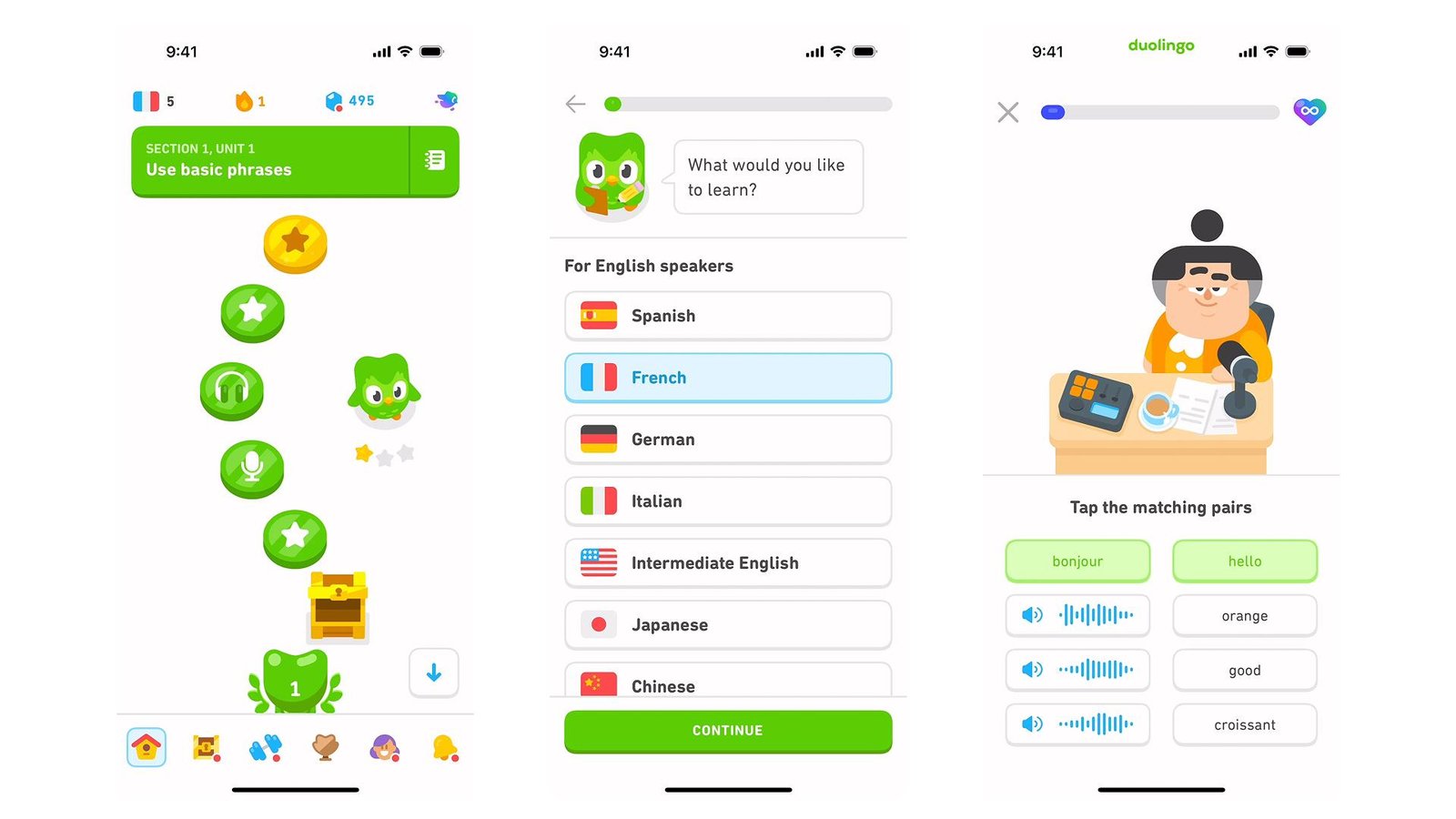
| ChatGPT | Duolingo | AI Speaking Apps | Human Tutor |
|---|
| Cost | Free / ~$20 mo | Free / ~$7 mo | $10–$30 mo | $15–$60+/hr |
| Personalization | Very high | Low (fixed path) | Medium–high | Highest |
| Speaking correction | Good (Voice Mode) | Basic | Strong, real-time | Best, nuanced |
| Availability | 24/7 | 24/7 | 24/7 | Scheduled |
| Best for | Writing, vocab, custom drills | Habit-building, basics | Pronunciation drills | Fluency, accountability |
Most learners get the best results by mixing tools rather than picking just one, using ChatGPT for volume and flexibility while filling the gaps it can't cover, like structured level testing and confidence tracking.
Limitations You Should Know
- It's not always accurate. ChatGPT occasionally gives a wrong grammar rule or a phrasal verb that isn't quite right. Cross-check anything you're not sure about.
- It can't officially score exams. Band and score estimates from ChatGPT are rough guides, not certified results.
- Conversations can feel repetitive or "too agreeable." It tends to praise your English even when you make mistakes unless you explicitly ask it to be strict.
- No real pronunciation scoring. Voice Mode understands you, but it doesn't give phoneme-level pronunciation feedback the way dedicated speech-recognition apps do.
- It can't replace human interaction. Timing, humor, and cultural nuance in real conversation are still hard to replicate.
Not sure where your English actually stands? Take the
English speaking confidence test to find your fluency level before you build a ChatGPT study routine around it.
FAQ
Can ChatGPT replace an English teacher?
No. It's strong for practice, correction, and generating unlimited example content, but it can't fully replicate human conversation timing, cultural nuance, or accountability. Combine it with a teacher, tutor, or speaking partner for best results.
Is ChatGPT accurate for grammar explanations?
Usually, but not always. It occasionally gives an incorrect example or mixes up a rule, especially with less common tenses or British/American differences. Ask it to double-check itself on anything unfamiliar.
Can children use ChatGPT to learn English?
Yes, with adult supervision. Kids can use it for simple conversations, vocabulary games, and story creation. Parents should review age requirements and monitor conversations, since it isn't designed specifically for children.
Is ChatGPT good for IELTS or TOEFL speaking practice?
It's useful for generating cue cards, practicing timed answers, and getting feedback on structure and vocabulary. It can't officially score your speaking band, so treat it as practice, not a scoring tool.
Should I use the free version or ChatGPT Plus to learn English?
Free is enough for most vocabulary, writing, and grammar practice. Plus is worth it mainly if you rely heavily on Voice Mode or want faster responses during longer sessions.
How do I turn on ChatGPT's voice mode to practice speaking?
Open the mobile app, start a new chat, and tap the headphone or waveform icon near the message bar. Speak naturally and ask ChatGPT to correct your pronunciation, grammar, or word choice afterward.