Your TOEIC score gets you shortlisted. What you say in the interview room gets you hired.
More Japanese companies are interviewing candidates in English than ever before. Rakuten made English its official in-house language years ago. SoftBank, Mercari, and a growing wave of startups now run entire interview loops in English, even for domestic hires. Add in the multinational firms based in Tokyo and Osaka, and English has quietly become a gatekeeper skill for corporate jobs in Japan, separate from, and sometimes more decisive than, your technical resume.
Here's the part almost no one tells candidates: a high TOEIC or EIKEN score does not automatically translate into interview performance. Reading comprehension and listening scores measure something very different from thinking on your feet, structuring an answer under pressure, and sounding confident without sounding arrogant, which, in Japanese business culture, is its own delicate balance. This guide covers exactly that gap.
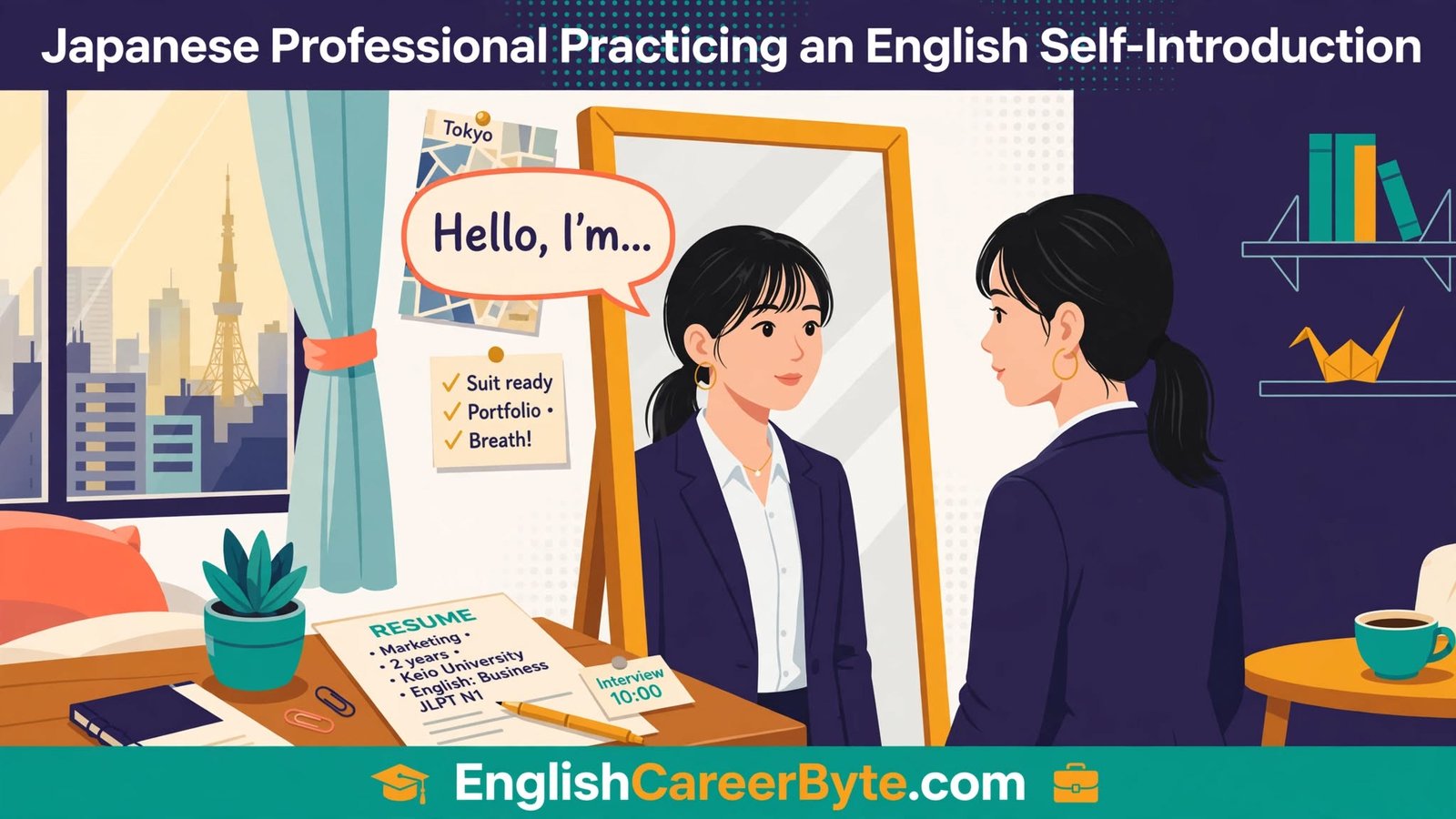
Western-style interviews reward direct, confident answers: "I led the project, I solved the problem, here's the measurable result." Japanese business culture traditionally rewards humility, deference to the team, and indirect self-praise. Put those two systems in the same room, and a candidate who answers "the correct Japanese way" can come across as vague or under-confident to an interviewer trained in Western-style hiring, even when the interviewer is Japanese themselves, because many companies now specifically train their interviewers to expect global business norms.
The core skill this guide teaches: how to keep the respect and humility that Japanese business culture values, while still answering with the clarity and ownership that an English-language interview expects.
Interviewers are rarely grading your grammar sentence by sentence. They're listening for three things:
A simple, grammatically imperfect answer that hits all three beats a beautifully worded answer that rambles without a clear point.
If your CV still needs work before you get to the interview stage, EnglishCareerByte's AI-powered resume generator can help you build an English CV that doesn't read like a direct translation.
In a Japanese interview, 自己紹介 (jikoshoukai) is a fixed, almost ceremonial opening. In an English corporate interview, the equivalent moment exists too, in the form of "tell me about yourself," but it's judged differently: less ceremony, more substance and confidence.
「はじめまして。〇〇と申します。よろしくお願いいたします。」
= "Nice to meet you. My name is ___. I look forward to working with you." This is good in Japanese, but too short and too formal for an English "tell me about yourself" answer.
Thirty to forty-five seconds is the target length. Longer than that, and you risk losing the interviewer's attention before the real questions even start.
Generic answers ("It's a famous company" / "I want to use my English") signal you didn't research anything. Name something specific, like a product, a stated value, or a recent expansion, and connect it to your own experience in one sentence.
You don't need to abandon humility to sound confident in English. You need different sentence structures. The trick is crediting the team while still clearly stating your own role.
In English business culture, naming your specific contribution isn't seen as boasting (自慢). It's seen as being clear and accountable. Interviewers need to know exactly what you did to evaluate you fairly.
| Mistake | Do this instead |
|---|---|
| Answering with a single word or short phrase ("Yes, I can.") | Add one sentence of context, even briefly: "Yes, I can. I've managed similar deadlines before." |
| Memorizing answers word-for-word | Memorize the structure (Situation, then Action, then Result), not the exact sentences. It sounds more natural and adapts to follow-up questions |
| Apologizing repeatedly before answering ("Sorry, my English is not good, but...") | Skip the apology entirely and answer directly. It's rarely noticed unless you point it out yourself |
| Long silence while translating in your head | Use a filler phrase to buy time: "That's a good question, let me think for a moment." |
Reading sample answers is not the same skill as producing them out loud, under time pressure, in front of a stranger. The gap between "I understand this answer" and "I can say this answer smoothly" is exactly where most candidates lose points.
For a full bank of practice questions beyond the ones here, EnglishCareerByte's guide to 50+ common job interview questions and answers is a solid next stop. If speaking on the spot, not writing, is where you freeze, their free pronunciation and speaking practice tool and English speaking confidence test will show you exactly where your fluency stands before the real interview does.
If the interview includes a discussion-style round or a panel meeting format, the phrasing patterns in EnglishCareerByte's guide to speaking English in business meetings, covering how to open, disagree politely, and summarize, map directly onto that format too.

A short thank-you email within 24 hours is standard in English-language corporate hiring, even though it isn't always expected in traditional Japanese hiring processes. Keep it to three sentences: thank them for their time, mention one specific thing discussed in the interview, and restate your interest.
EnglishCareerByte's guide to writing professional emails in English has ready templates and tone guidance for exactly this kind of message.
No. Interviewers are trained to focus on clarity and structure, not accent. A clear, well-organized answer with a noticeable accent will score higher than a hesitant, unstructured answer with perfect pronunciation.
Not by itself. TOEIC measures reading and listening comprehension, not spontaneous speaking under pressure, which is the actual skill tested in an interview. Speaking practice is a separate skill that needs separate preparation.
No. Memorize the structure of each answer instead, such as Situation, Action, and Result, so you can adapt naturally to follow-up questions without sounding robotic.
Yes. A brief pause with a filler phrase like "That's a good question, let me think for a moment" is completely normal and reads as thoughtful, not weak.
English interviews generally expect more direct ownership of your individual contributions, while still valuing teamwork. The balance point covered earlier in this guide is the main adjustment most candidates need to make.
An English corporate interview in Japan isn't testing whether you sound like a native speaker. It's testing whether you can think clearly, structure an answer, and stay composed under pressure, in a second language, in a room that may still expect Japanese-style humility alongside Western-style directness. That balance is learnable with the right practice, not something you're either born with or without.
Join a free trial class with EnglishCareerByte and run a live mock interview before the real one.
Start Free Trial →