
Wherever you're freelancing from, the same simple structure gets you hired. Here's the full method, plus guides built for your specific region.
There are freelancers on every continent competing for the same Upwork jobs, the same Fiverr buyers, and the same client budgets. Technical skill narrows the field a little. English communication is often what actually decides who gets picked. Not because clients demand perfect grammar, but because a proposal or a message that reads clearly and confidently signals something bigger: that this freelancer will be easy to work with.
The good news is that this skill has nothing to do with being a native speaker. It comes down to a handful of repeatable habits: how you structure a proposal, how you word an upsell, how you handle a difficult client message, and how you practice saying all of it out loud until it's automatic. This guide covers the complete method, and it works the same whether you're freelancing from São Paulo, Manila, Lagos, or Karachi.

Most freelancers assume the issue is vocabulary. It rarely is. A client scanning fifteen proposals in a row skips anything that looks like a wall of text, even when every sentence in it is grammatically correct.
The rule that matters most: short sentences and clear structure win more contracts than advanced vocabulary ever will.
Don't open by talking about yourself. Open with the client's problem. The structure that works everywhere is Problem, then Solution, then Proof.
Every sentence here is short. There's no advanced vocabulary and no need for a perfect accent, because it's written communication, and it reads like it came from someone who has done this many times before.
Once you land a client, the fastest way to grow your income is earning more from the ones you already have. The trick is framing the extra service as a benefit to the client, not as an extra cost to them.
Prepare three or four of these lines in advance for your specific service. You won't need to invent them mid-conversation, and you can reuse the same ones with every client.
Every freelancer eventually deals with a missed deadline or an unhappy client. The technique that works in almost any culture is acknowledging the client's concern before explaining anything.
Neither of these apologizes excessively or sounds defensive. Both lead with the client's interest and end with a concrete next step, and that combination is what makes a message sound senior.
| Instead of… | Use… | Example |
|---|---|---|
| Fix | Resolve | "I will resolve this issue immediately." |
| Tell | Inform / Update | "I will update you as soon as the draft is ready." |
| Help | Assist | "I would love to assist you with scaling your brand." |
| Send | Deliver | "I will deliver the final files by Friday." |
| Wait | Allow time | "Please allow 24 hours for the final review." |
The core method stays the same everywhere, but each platform rewards slightly different habits.
If Fiverr is one of your main platforms, EnglishCareerByte's Fiverr gig description guide with 10 templates applies this exact structure directly to gig listings.
Every language creates its own version of the same problem: fluent-sounding sentences that don't quite match how a native English speaker builds them. A few common ones, from a few different languages, show the pattern.
| Language influence | Common phrasing | Say this instead |
|---|---|---|
| Spanish (actualmente) | "Actually, I'm working on the homepage." | "Currently, I'm working on the homepage." |
| Portuguese (fechamento) | "I will make the checkout of your project." | "I am wrapping up the final deliverables for your review." |
| Hindi/Urdu (structure carried over) | "Kindly do the needful." | "Please take care of this," or name the specific action needed. |
| French (assister à) | "I will assist to the call." | "I will attend the call," or "I will join the call." |
None of these are grammar mistakes. That's exactly why they're hard to catch on your own. They sound fluent, but a native reader pauses slightly on each one, and a client scanning ten proposals in a row won't give a message that second read.
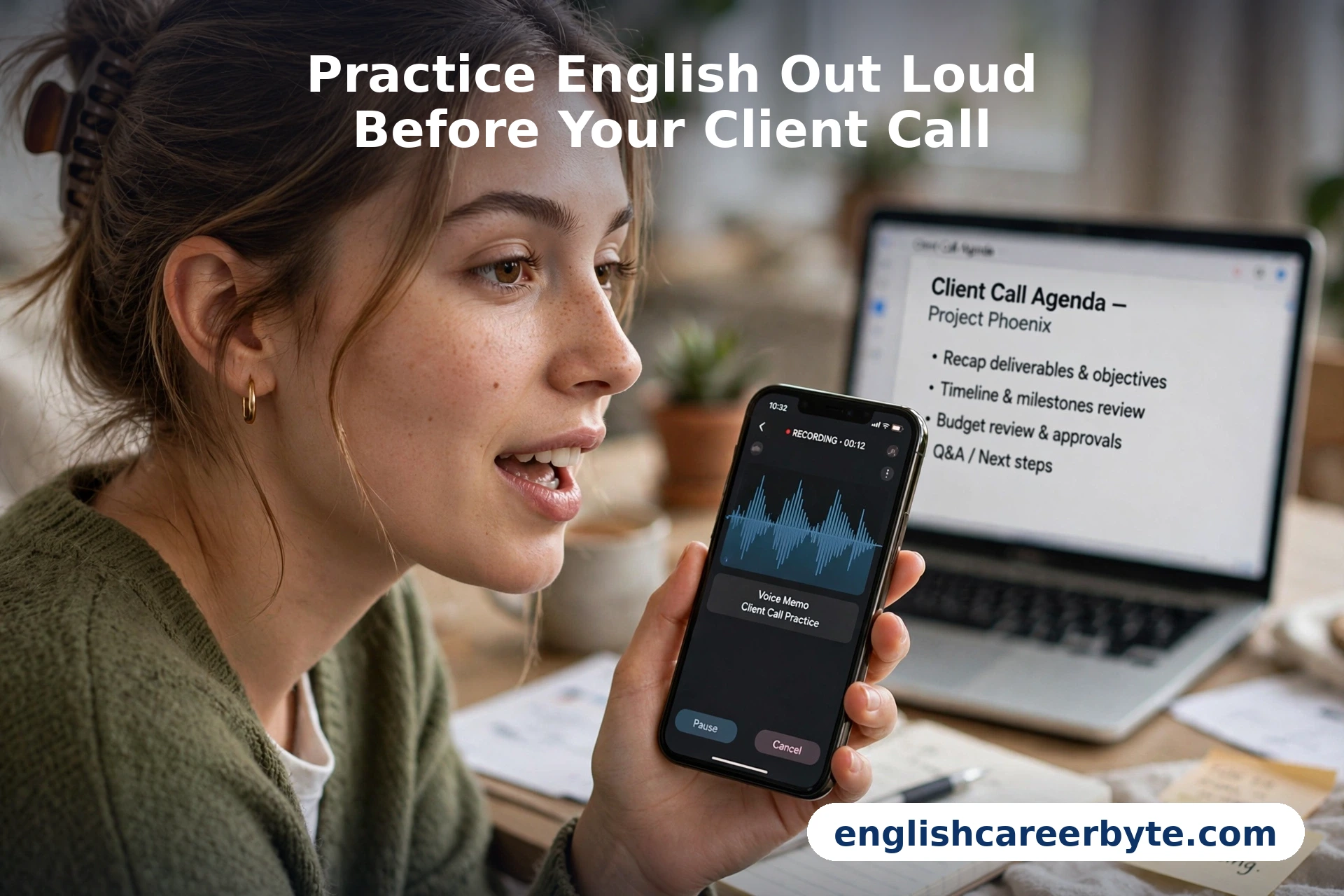
Reading these phrases is one skill. Saying them out loud on a live call, without hesitating or searching for a word mid-sentence, is a different one, and it's exactly what gets tested when a client jumps on a video call to discuss scope.
If calls are where the hesitation shows up most, EnglishCareerByte's guide to speaking English in business meetings has the exact phrases for opening a call, disagreeing politely, and closing with next steps. Their free English speaking confidence test shows you where your fluency stands right now, and their free pronunciation and speaking practice tool is built for rehearsing these exact phrases until they come out automatically.
None of the habits in this guide require a paid course to practice. EnglishCareerByte's free tools cover the writing, speaking, and CV side of freelancing in one place.
Find your current spoken fluency level in a few minutes.
Take the testRehearse client phrases out loud until they sound automatic.
Try it freeBuild an English CV or portfolio bio that doesn't read like a translation.
Generate your resumeGet a quick, honest read on your overall English level before you start pitching.
Take the quizA curated roundup of other free tools worth adding to your practice routine.
See the roundupThe method above works everywhere, but a few local habits are worth addressing directly. These regional guides go deeper into the specific patterns freelancers from each country run into.
No. Clients care more about clarity, structure, and reliability than accent or advanced vocabulary. A short, well-organized message beats a long, polished one almost every time.
Both matter, but for most freelancers writing comes first, since proposals and messages happen before any call. Speaking becomes critical once a client wants to discuss scope live.
Keep a personal list of your own repeated translation habits, similar to the examples in this guide, and review it before sending messages for a few weeks. Most freelancers only make five to ten recurring ones.
Yes. Simple, clear English is often preferred over complex vocabulary, since it is faster to read and leaves no room for misunderstanding scope or deadlines.
Yes, though the format changes slightly. Upwork rewards a strong opening line, Fiverr rewards a structured gig description, and cold outreach rewards brevity above all else.
International clients aren't grading your English against a native speaker's. They're deciding, in about thirty seconds, whether they trust you with their project and their money. Structure, clarity, and a bit of daily speaking practice close that gap faster than years of grammar study ever could, no matter which country you're freelancing from.
Join a free trial class with EnglishCareerByte and rehearse real client conversations before the real one.
Start Free Trial →